


The Practice Of Management
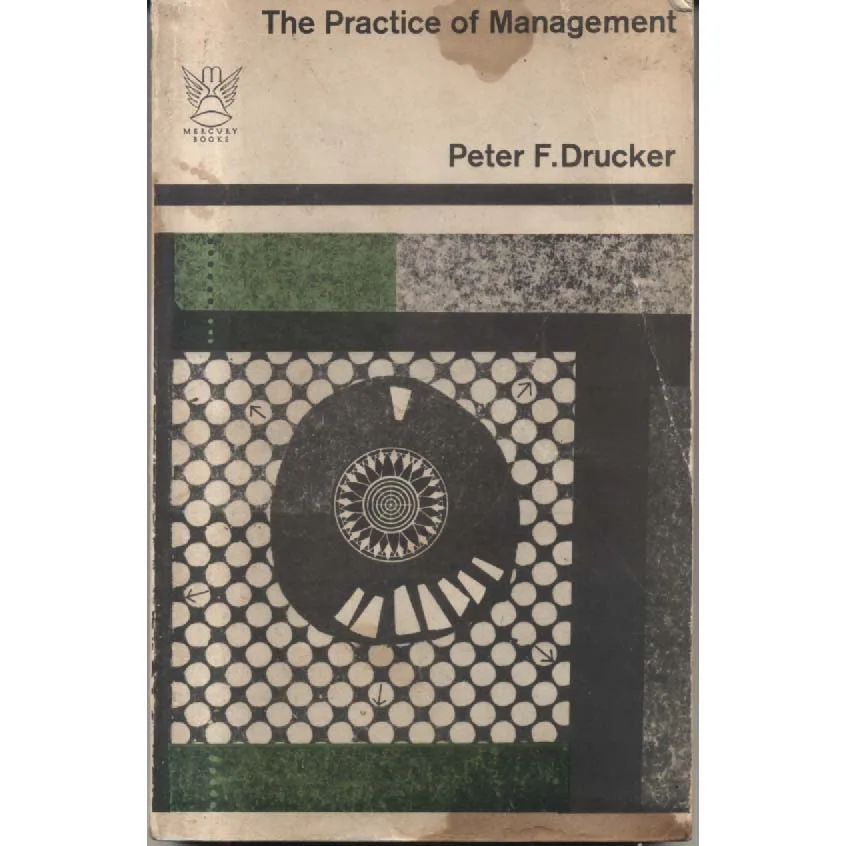
Publisher: Mercury Books
Format: Paperback
ISBN: none
Some books promise to change the way you think. The Practice of Management goes a step further and suggests, with terrifying calm, that management itself might actually be a thing one can study, define, and perhaps even do on purpose.
Written by Peter F. Drucker and here in a 1961 Mercury Books edition, this is one of those immensely influential titles that has spent decades quietly shaping offices, boardrooms, industries and the language of work itself, all while sounding as thrilling as a municipal handbook. Which is part of its genius. The title does not seduce. It does not flirt. It simply announces that management exists, it has a practice, and Peter Drucker is here to explain it. A lesser book might have called itself Lead to Win! or The Seven Habits of Organisational Excellence. This one has the confidence to be almost sternly plain.
And plainness, in this case, is a mark of power. Drucker is one of those rare writers whose ideas became so widely absorbed that much of what he said now feels obvious—until you remember that someone had to say it first. The notion that a business should be managed with clarity, responsibility, objectives, structure and an awareness of people as well as profits was not always the universal wallpaper of managerial thought. At one point, this was fresh, formidable stuff. Entire generations of executives, consultants and earnest middle managers have been living in Peter Drucker’s conceptual afterglow ever since.
There is something rather marvellous about old management books because they reveal the moment when modern work was being invented in real time. This is not just a book about bosses. It is a book about the whole strange machine of organised human effort: what businesses are for, what managers actually do, how decisions are made, how workers fit into the system, how institutions survive, and how not to run everything like a confused family argument with filing cabinets. It takes the shapeless chaos of “work” and tries to turn it into a coherent discipline. A brave undertaking, even now.
Naturally, there is also a deep irony in the phrase The Practice of Management. It sounds so clean. So orderly. So reassuringly professional. Anyone who has ever worked anywhere knows that management in practice often involves a great deal of improvisation, misplaced confidence, meeting rooms, memos, and someone asking for an update on something no one fully understands. Drucker’s book stands as a monument to the noble hope that this muddle might be improved by thought. Not eliminated, of course. Let us not get fanciful. But improved.
That is why the book remains appealing beyond the business shelf. It is not merely corporate doctrine. It is a historical artefact from the age when the modern organisation was being taken very seriously indeed. Factories, firms, departments, executives, performance, responsibility, growth: all the architecture of twentieth-century work sits here in concentrated form. To read Drucker is to hear the serious voice of a man trying to make institutions smarter before they become too large, too clumsy and too convinced of their own brilliance. Which, in hindsight, was a perfectly reasonable concern.
As sold by Crappy Old Books, this copy is in Good condition, which feels entirely fitting. A management classic should not be too glossy. It ought to look as though it has been carried, consulted, perhaps underlined by someone determined to improve a division, save a company, or at least sound more authoritative in meetings. Good condition suggests it has endured the decades with dignity intact, surviving the rise and fall of management fashions, jargon revolutions and countless later books pretending to say something new while really just rearranging Drucker.
There is also a special pleasure in the Mercury Books edition itself. A serious text in accessible form, from a period when ideas were expected to circulate widely and not merely sit in expensive hardbacks on executive shelves. It gives the book a democratic air. Here is management theory not as luxury branding, but as something to be read, argued with and put to use. A paperback blueprint for making the machinery of capitalism slightly less idiotic.
For collectors of business history, readers interested in twentieth-century thought, lovers of serious nonfiction, or anyone fascinated by the origins of modern managerial language, this is a splendid find. It is intelligent, foundational, slightly severe and unexpectedly revealing about how the postwar world imagined efficiency, responsibility and organised power. Also, it makes a wonderful object to own if you enjoy the quiet comedy of books whose titles sound unbearably dry but whose influence turns out to be enormous.
The Practice of Management is not a glamorous book. It is far too busy inventing half the assumptions of modern business for that. But it is sharp, important and oddly bracing. A book that looked at the chaotic business world and said, in effect, let us at least try to run this properly.
Condition: Good. Sensible, solid and still full of advice for anyone bold enough to manage other human beings. Sold by Crappy Old Books.
Keep browsing: See more Business books Other books by Peter F Drucker
